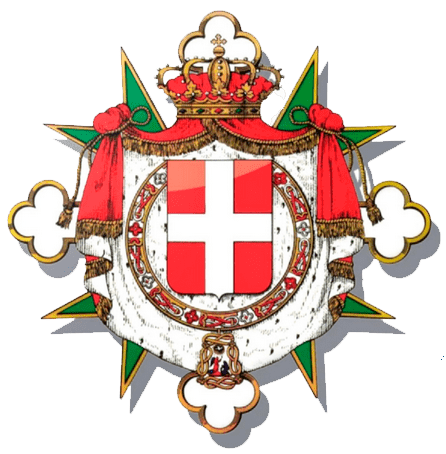
Order of Saint Maurice and Lazarus
The Order of St. Lazarus was founded in Jerusalem during the Crusades. The convention of St. Lazarus was firstly mentioned in 1155, and since 1227 the relevant order has been mentioned in the documents. Its duty was to guard over lepers and to protect the pilgrims going to the Holy Sepulcher. The monks of the Order of St. Lazarus had an extensive network of hospitals and churches in all the states founded by the Crusaders. It is from the name of the Order of St. Lazarus that the term 'lazarette' is derived. The patron of the order was one of the Gospel heroes resurrected by Christ: his name was Lazarus, later the Bishop of Marseilles, who was martyred.

In 1291, after the fall of Akka, the last crusader fortress in Palestine, the knights of the Order of St. Lazarus had to leave the Holy Land to move to the Kingdom of the Two Sicilies and to France, where they founded many hospitals. Due to the decrease in the number of gentlemen, in 1490, the Order of St. Lazarus submitted to the Order of Johannites (later known as the Maltese Order). However, on May 4, 1565, Pope Pius IV restored the legal and organizational independence of the order, but the Grand Master, Jannoto Castiglione, failed to restore the order structure. In 1572, Duke Amadeus of Savoy made him recognize of his sovereignty over the commandments of St. Lazarus, that existed in the possessions of the Dukes of Savoy.

After that, the Order of St. Maurice received the name of the Order of St. Maurice and Lazarus, and on January 15, 1573, the Pope approved a new united order of medals, including the white cross of St. Maurice and the green cross of St. Lazarus. The new Order of Savoy inherited the traditional mission of patronizing the ill from the Order of St. Lazarus. Having two patrons, the order celebrates both St. Mauritius Day (September, 22) and St. Lazarus (December, 17).
When the Italian Kingdom was established, the order was preserved as one of the highest awards; it was also provided with the possessions confiscated after 1860 from the Constantine Order of St. George - the dynastic order of the Parma Grand Duchy House and the Royal House of Two Sicilies, and the Order of St. Stephen, which belonged to the Tuscan dukes of the Hapsburg dynasty. At the same time, the Order lost its religious character, the corresponding vows were canceled, nevertheless, its humanitarian activities never stopped. The Order ran hospitals in Turin, Aosta, Valenza, Lanzo, Lucerne. As early as 1848, the former obligation to prove the evidence of noble origin, upon the award of the order, was abolished, and since then it could be granted for service to people of non-noble origin.
-
Since 1868, the Order has five grades.
- The highest of them is the bearer of the great cross (gentlemane di Gran Croce),
- Second grade - a great officer (grande ufficiale),
- Third grade - commander (commendatore),
- Fourth - officer (ufficiale),
- Fifth - gentleman (gentlemane);
The same division exists in the French Order of the Legion of Honor. In 1839, the golden Mavrikian Medal was established, which was received by those who served in the armed forces for 50 years (later its status changed, and it is curious that this medal was preserved in 1946 by the Italian Republic which it is no longer associated with).


This order was retained by the House of Savoy after the overthrow of the monarchy. King Umberto II, forced in 1946 to retire into exile, did not abdicate the throne and until his very death (in 1983) was considered the legitimate Italian monarch. His son and heir, Prince Victor Emmanuel (de jure king Victor Emmanuel IV), without using the royal title, retains the hereditary title of the Grand Master of dynastic orders.
On June 11, 1985, Prince Victor-Emmaunil, the head of the House of Savoy and the seventeenth Grand Master, approved the new status of the Order of Saint Maurice and Lazarus. It is noted that this order is awarded for merits in the military and civil service, in science, literature, art, commerce, industry, humanitarian and other charitable activities.
-
As before, there are five classes for awarding men:
- The Big Cross (the number of awards is not more than 50),
- The Large Officer’s Cross (no more than 100 awards) and the Hereditary Commander’s Cross under the patronage right (no more than 50 awards),
- The Commander's Cross (not more than 200 awards),
- The Officer's Cross (no more than 400 awards) and the Gentleman's Cross (the number of gentlemen is not limited).
-
There are three classes of awards for ladies:
- The number of Ladies of a Large Cross should not exceed 50,
- The number of the Ladies of the Commanders’ Cross should not exceed 200,
- The number of the Ladies of the Third-Class Cross is not limited.
An order medal for the merits of three grades (gold, silver and bronze) with the image of the order cross and the inscription “Bene Merenti” on the back (32 mm in diameter), which is worn on a green award ribbon, was also established.
The order's badge is a heraldic cross of St. Lazarus with white enamel imposed on the gold with green enamel eight-pointed cross of the Maltese type. The ribbon of the order is light green (the so-called "apple" color). The badges of the first-grade order form a large cross (67mm in diameter), topped with a golden royal crown, and an eight-pointed silver breast star (85mm in diameter) decorated with the same cross of the Order. The cross of the second grade - the big officer one - is 50mm in diameter, and is also surmounted by a golden royal crown. It is worn on the neck ribbon and is also accompanied by a star, but a smaller one (75mm in diameter), and is four-pointed. The patrimonial commander (commendatore di guispatronato) wears the same cross on his neck as a great officer, and in the form of a breast star - the same, but a larger cross. The mark of the commander is the same neck cross as that of the great officers and tribal commanders, but without a star. Officers wear a smaller cross (35mm in diameter), also topped with a golden crown, on a ribbon on the left side of the chest. Knights (gentlemen) wear a cross of the same size as officers, but without the royal crown. Ladies of the big cross wear a cross (37 mm in diameter), topped with a crown on a simple ribbon decorated with gold embroidery. The ladies of the commander’s rank are given the same cross, but there is no sewing on the bow; and finally, ladies, awarded with a cross of the third class, wear a cross without a crown. The Knights of the Order used to wear a complex dark green military uniform, but now this tradition is no longer maintained. In solemn occasions, knights may wear order decoration, which is a purple silk robe (robe) with a large cross embroidered on the chest. On the mantles of gentlemen of the 1 and 2 grades, there are also embroidered order stars of the appropriate form, and on the mantles of the commanders and officers there are circles with a royal crown embroidered in a circle, sewing, respectively, gold or silver.
For more information about the Dynastic orders of the House of Savoy and its activities see the official website.