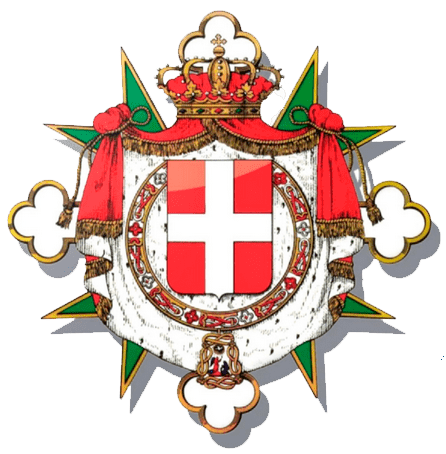
Dynastic Orders of the Italian (Savoy) House
Knightly orders that originated as military corporations, modeled on monastic congregations, later, with rare exceptions, were subordinated to secular monarchs. The heads of the ruling dynasties became hereditary great masters of the previously existing and newly established orders. These orders, first retained the old military structure. The oldest orders: the Golden Fleece, the Holy Spirit, the Garter, St. Michael's, the Annunciation Order etc., limited the number of gentlemen recruiting only the highest nobility. Later, other orders appeared; they became the insignia for military service and civil merit. Many of them still stuck to knightly traditions and attributes (for example, mantles, knight's cloaks, and later - ceremonial military uniforms as a sign of belonging to the order). In some countries, persons of non-noble origin, granted gentlemen of various orders quite often (although not always) received the rights of the nobility.
In the XVIII century. the uniforms of the Russian military and civil officers were decorated with awards of many European countries: Austria, Prussian, Bavaria and other states awarded the heroes of the Patriotic War of 1812, who reached Paris. The Bulgarian, Serbian, Romanian orders were received by many Russian officers who took part in the 1877-1878 liberation campaign in the Balkans. Foreign sovereigns and princes who visited Russia, bestowed their orders on not only the highest dignitaries and persons who participated in the preparation of visits, but also, for example, regimental officers, colonels-in-chief. At that time, foreign awards could be accepted and carried only with the highest permission (however, it was only a formality).
The disappearance of some formerly sovereign kingdoms and principalities in the XIX century, the destruction of many European monarchies in the XX century made many orders, known for centuries, lose the status of state awards, thus, some of them disappeared. However, many of them were kept by the monarchs in exile as tribal, dynastic orders. In some cases, they were recognized as family-dynastic, non-state by the new republican authorities; sometimes they could only be used abroad. Nevertheless, the ruling monarchs recognized the dynasties in exile as a legal institution, recognized and accepted those dynastic awards. Some dynasties retained their orders only as an attribute used only by members of the family, others still have fairly developed order structures usually associated with charity.

The oldest Italian royal orders, dynastic orders of the Savoy House arose even before the Italian kingdom started in the Duchy of Savoy. Today, their Grand Master is the Head of the Italian Royal House, Prince Victor Emmanuel (Vittorio Emmanuele), Prince of Naples and Duke of Savoy (de jure King Victor Emmanuel IV).

The highest Order of the Annunciation (Sanctissima Annunziata) was founded in 1362 by Duke Amadeus VI of Savoy. Initially, there were supposed to be only 14 gentlemen led by the Grand Master; subsequently, the number of gentlemen was slightly increased. In 1570, it was ruled that the gentleman of this order must prove his nobility in at least five generations. In 1924, King Victor Emmanuel said that the number of gentlemen of the Order would be twenty people, but this number did not include the princes of the royal house, representatives of the highest clergy, as well as foreign monarchs and princes.
The badges of the order are the gold chain and the patterned medallion depicting the Annunciation, and the star with the same image (introduced in 1780). The chains of the order were given to gentlemen for life, and after their death they were to be returned to the Great Master: therefore, the current holders of the Order sometimes carry the signs that have been used for several centuries. Gentlemen of this order can only be male. One of the honorary privileges granted is the right to be called the cousin of the king - the Grand Master of the Order.

Among the gentlemen of this order in Russia there was Generalissimo Count A. Suvorov-Rymniksky, Prince of Italica (awarded for his Italian campaign), some members of the Russian Imperial House, including Emperor Nicholas II, Grand Dukes Mikhail, Nikolai and Peter. The Head of the Russian Imperial House in Exile, Grand Duke Vladimir Kirillovich, was also a knight of this order. After his death in 1992, in accordance with tradition, his insignia was transmitted to the head of the Italian royal house, Prince Victor Emmanuel, and they were granted to the grandson of the sovereign, Grand Duke Georgiy. As before, the Order of the Annunciation remains a rare and very honorable award, available, as a rule, only to representatives of royal families.

The Savoy House owns another old European order – the Order of Saints Maurice and Lazarus.
The holy martyr, the Roman warrior of Maurice, who died in 286 AD, has long been considered the patron saint of the House of Savoy. In his honor a monastic community was founded in 1434 by Duke Amadeus VIII, who abdicated the throne and settled in a monastery with several of his former courtiers, but this first knightly association in honor of St. Maurice did not last long. On September 16, 1572, the Order of St. Maurice was re-established by the bull of Pope Gregory XIII, and soon, the pope confirmed with a special certificate that the title of Grand Master was forever assigned to Duke Philibert of Savoy and his successors.
Other orders existing in Italy until 1946, for example, Order of the Crown of Italy, have not been used any more for dozens of years. However, the Civil Order of the House of Savoy (Ordine Civile di Savoia), established in 1831 by King Carl Albert, was formally preserved, having only one grade. Its sign is a straight golden cross with blue enamel; in the central medallion, on white enamel, there is the gold monogram of the founder of the order - C.A. The ribbon of the order is white-azure-white.
On January 23, 1988, the current head of the royal house, Prince Victor Emmanuel, established the Order of Civil Law of Savoy (Ordine al Merito Civile di Savoia); its form resembles to the Civil Order, but the golden cross is covered with white enamel, and in the centre there is a round medallion on the blue enamel with the golden initials of the prince – V.E. This order has five grades for men and three for women, the same as in the Order of Saints Maurice and Lazarus (gentlemen and ladies of the Big Cross, great officers, commanders and ladies of the commander’s rank, officers, and, finally, just gentlemen and ladies). The ribbon is white with blue (azure) edges (the central strip is a bit wider). The order is awarded for special services to the Savoy House.
Gentlemen and ladies of the Order of Saints Maurice and Lazarus and the Order of Savoy for civil merits are obliged to pay not only the entrance fee to the Gentlemen’ Association (varying according to grade), but must also pay membership dues annually: these amounts are used to finance the Order’s multilateral charitable activities.
According to the all-European (including Russian) traditions of the order, they can be depicted in the emblems of the persons awarded by them. The last (rather traditional) version of the rules determining the use of Italian dynastic orders in the arms, was approved by Prince Victor Emmanuel on June 11, 1985.
For more information about the Dynastic orders of the House of Savoy and its activities see the official website.